
Salt Spray Chamber for Accelerated Corrosion & Coating Resistance Testing
A Salt Spray Chamber is a specialised corrosion testing system designed to evaluate the resistance of metals, coatings, plating, fasteners, and components against controlled salt fog exposure. It helps manufacturers identify corrosion, coating defects, and surface degradation before products enter demanding operating environments.
As a Salt Spray Chamber manufacturer, Comet Environs designs industrial systems for controlled salt fog generation, uniform exposure, repeatable testing cycles, and reliable operation. Our solutions are suitable for automotive, aerospace, defence, marine, electronics, coatings, fasteners, and industrial applications.
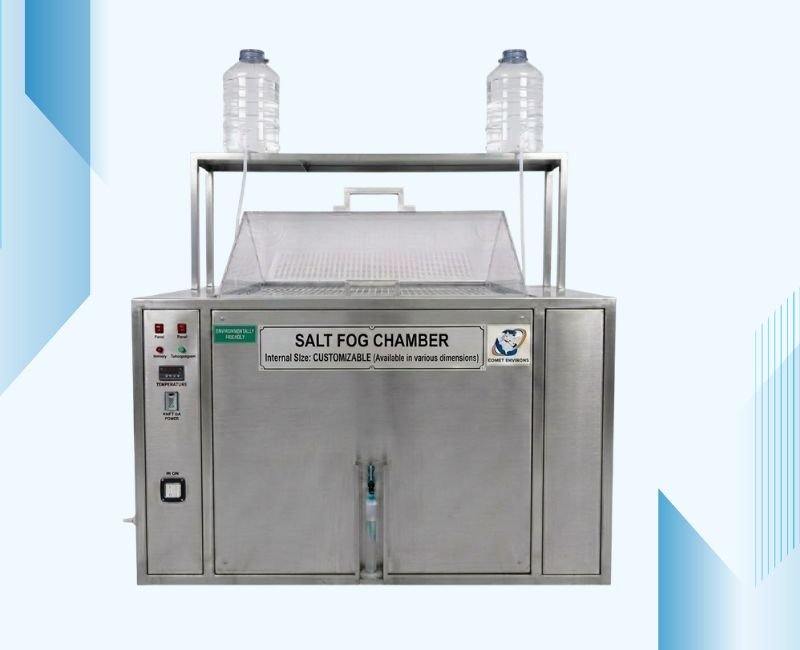
Salt Spray Chamber – Process and Working Principle
A programmable Salt Spray Chamber exposes test specimens to a controlled fine salt mist inside an enclosed test area. The salt solution is atomised through spray nozzles to create a consistent corrosive environment around the test samples.
The testing process includes:
Preparation of the salt solution
Controlled salt solution supply
Fine mist generation through spray nozzles
Controlled chamber temperature
Uniform salt fog exposure
Defined test duration
For Neutral Salt Spray (NSS) testing, typical conditions include a 5% NaCl solution, controlled pH of approximately 6.5–7.2, and chamber temperature around 35°C ±2°C.
Salt Spray Chamber Benefits – Corrosion & Coating Validation
Using a high-performance Salt Spray Chamber helps manufacturers evaluate corrosion resistance under controlled and repeatable conditions.
Key benefits include:
Early detection of corrosion and coating defects
Comparative evaluation of surface treatments
Repeatable corrosion testing
Support for product qualification
Improved coating and material selection
Better quality control
Reduced product failure risks
Improved R&D efficiency
Salt spray testing allows manufacturers to compare coatings, materials, and treatments under consistent laboratory conditions.
Applications of Salt Spray Chamber in Industry
A heavy-duty Salt Spray Chamber is widely used where corrosion resistance is critical.

Aerospace & Defence
Aerospace & Defence
• Aerospace components
• Defence hardware
• Protective coatings
• Metal assemblies
• Military equipment

Electronics & Telecommunications
Electronics & Telecommunications
• Electrical enclosures
• Connectors
• PCBs
• Terminals
• Outdoor electronic equipment

Automotive & Electric Vehicles
Automotive & Electric Vehicles
• Automotive frames
• Fasteners
• Coated components
• Exhaust parts
• Suspension components
• EV components

Marine & Off-Road Equipment
Marine & Off-Road Equipment
• Marine hardware
• Offshore components
• Agricultural machinery
• Salt-exposed equipment

Coatings & Surface Treatment
Coatings & Surface Treatment
• Paints and primers
• Powder coatings
• Electroplating
• Galvanising
• Protective finishes
Salt Spray Chamber – Technical Specifications
Every Salt Spray Chamber is engineered around the required test method, specimen size, capacity, and applicable standard.
Salt Solution
• 5% NaCl / 50 g/L
• pH: 6.5–7.2 for NSS testing
Temperature
• 35°C ±2°C for NSS testing
Spray System
• Spray pressure: 0.7–1.4 bar
• Fog collection: 1–2 mL/hr per 80 cm²
• Uniform salt mist distribution
Control System
• PLC/PID touchscreen controller
• Programmable test cycles
• Data logging
• LAN connectivity
Construction
• GRP or stainless-steel chamber construction
• Corrosion-resistant fixtures
• Chemical-resistant internal components
Safety
• Dry-seal lid gasket
• Automatic purge
• Over-temperature alarm
• Low-fluid alarm
Types and Variants of Salt Spray Chamber
To meet different testing requirements, Comet Environs offers multiple Salt Spray Chamber configurations.

Floor-Standing Salt Spray Chamber
Floor-Standing Salt Spray Chamber
Designed for routine industrial quality control and batch testing.
Custom Salt Spray Chamber
Custom Salt Spray Chamber
Custom configurations can include:
• Special chamber dimensions
• Higher specimen capacity
• Multiple spray nozzles
• Special fixtures
• PLC automation
• Application-specific test arrangements
Corrosion Failure Analysis & Testing Standards
A professional Salt Spray Chamber helps manufacturers identify corrosion-related failures while evaluating products against recognised testing standards.
| Failure Mode | Relevant Testing Standards |
|---|---|
| Red rust formation | ASTM B117, ISO 9227 |
| White corrosion products | ASTM B117, ISO 9227 |
| Coating blistering | ASTM B117, ISO 9227 |
| Coating peeling | ASTM B117, ISO 9227 |
| Surface corrosion | ASTM B117, ISO 9227 |
| Pitting and coating defects | ISO 9227 |
| Plating defects | ASTM B117, JIS Z 2371 |
| Coating degradation | ASTM B117, ASTM G85 |
| Accelerated corrosion of coated surfaces | ASTM B368, ISO 9227 |
Supported Standards
• ASTM B117 – Salt Spray Fog Testing
• ISO 9227 – Salt Spray Tests
• JIS Z 2371 – Salt Spray Testing
• ASTM B368 – Copper-Accelerated Acetic Acid Salt Spray
• ASTM G85 – Modified Salt Spray Testing
The applicable method and chamber configuration should be selected according to the product specification and required test protocol.
Salt Spray Chamber Selection Criteria
Selecting the right Salt Spray Chamber ensures reliable testing and efficient laboratory operation.

Applicable testing standard
Test method such as NSS, AASS, CASS, or cyclic testing
Test specimen size
Chamber capacity
Required exposure duration
Spray distribution requirements
Safety & Reliability of Salt Spray Chamber
A professional Salt Spray Chamber requires corrosion-resistant construction and suitable safety systems for reliable operation.
Digital temperature monitoring
Low-fluid alarm
Spray system monitoring
Corrosion-resistant internal construction
Over-temperature protection
Automatic purge system
Dry-seal gasket
Operator safety provisions
Salt Spray Chamber Manufacturer – Why Choose Comet Environs
Comet Environs provides industrial Salt Spray Chambers designed around application requirements, testing standards, and long-term operational needs.
40+ Years of Engineering Experience
In-house Design & Manufacturing
Custom Chamber Configurations
Advanced PLC Control Systems
ISO/IEC 17025:2017 NABL Accredited Laboratory
Installation, Calibration & AMC Support
PAN India Technical Support
Our engineering team can customise chamber volume, spray configuration, fixtures, PLC features, and other requirements according to the application.
Frequently Asked Questions
What is a Salt Spray Chamber used for?
A Salt Spray Chamber is used to evaluate the corrosion resistance of metals, coatings, plating, fasteners, and components under controlled salt fog exposure.
Which industries use Salt Spray Chambers?
Automotive, EV, aerospace, defence, marine, electronics, construction, coatings, fasteners, and industrial manufacturing industries use salt spray testing.
Can Salt Spray Chambers be customised?
Yes. Chamber size, spray arrangement, fixtures, automation, capacity, and other features can be customised according to the application.
What is an NSS Salt Spray Chamber?
NSS stands for Neutral Salt Spray. It typically uses a 5% NaCl solution with controlled pH and approximately 35°C chamber temperature.
Which standards does the Salt Spray Chamber support?
Depending on configuration, the chamber can support ASTM B117, ISO 9227, JIS Z 2371, ASTM B368, and ASTM G85.
Do you provide installation and maintenance?
Yes. Comet Environs provides installation, commissioning, operator training, calibration, and AMC support across India.
Contact Our Salt Spray Chamber Experts
A reliable Salt Spray Chamber helps manufacturers evaluate corrosion resistance, coating performance, and material durability under controlled salt fog conditions.
Comet Environs manufactures standard and customised Salt Spray Chambers for R&D, quality control, product qualification, and industrial corrosion testing.